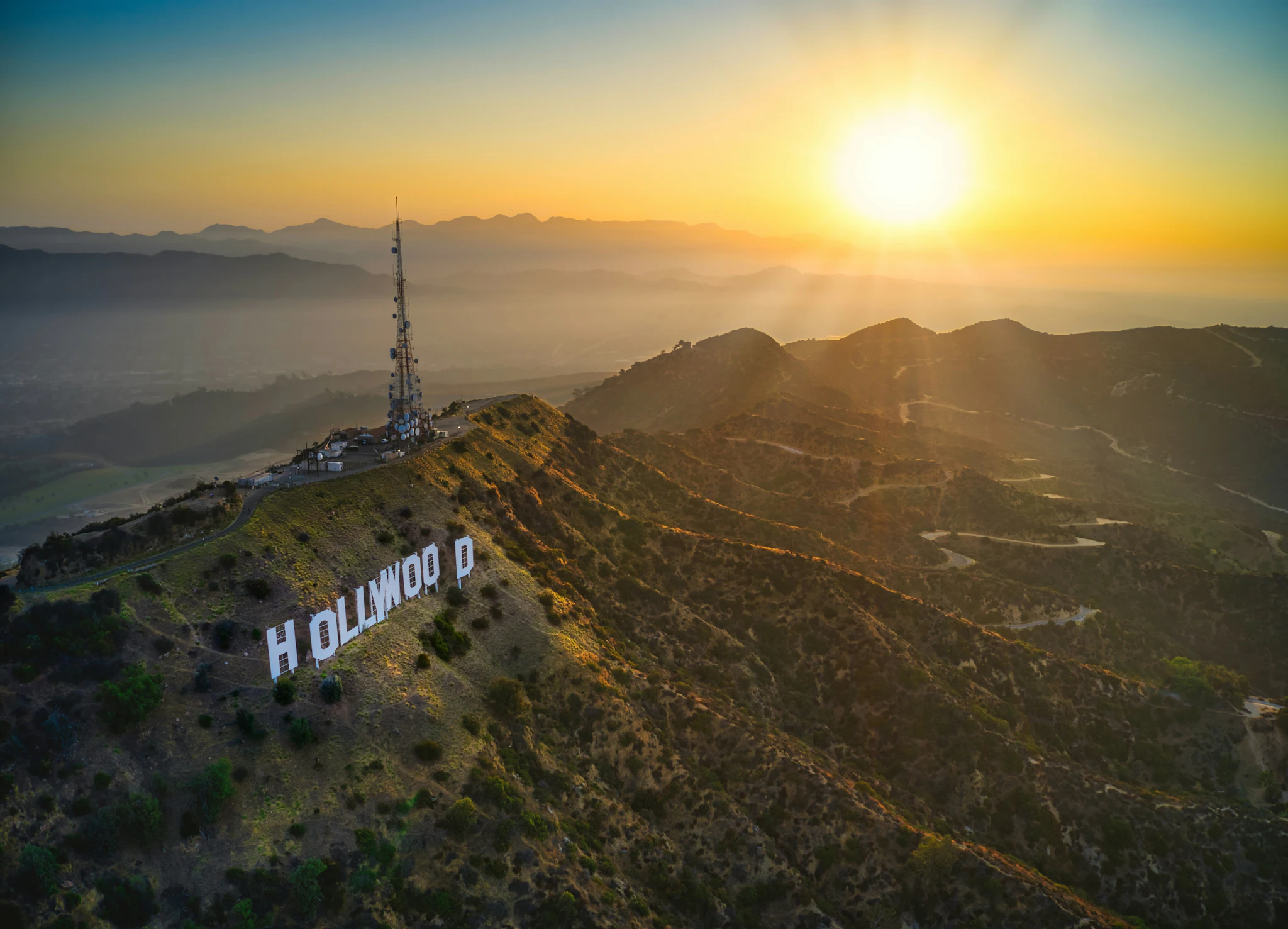
From a private estate, guests can be minutes from a canyon trail, a paved reservoir loop, a Mulholland overlook, or one of the clearest legal views of the Hollywood Sign. The setting is still unmistakably Los Angeles, but the pace is different from the neighborhoods below. Mornings are quieter. The roads bend into the hillside. The views change from one canyon to the next.
This is where the Hills are strongest. The area is not built around a single beach, shopping street, or restaurant corridor. It is built around elevation, privacy, architecture, and access to open space inside the city.
For guests staying here, the best outdoor experiences are not complicated. Start early. Choose the right entrance. Avoid the residential access issues around the Hollywood Sign. Let the rest of the day unfold back at the estate.
Start Early at Runyon Canyon
Runyon Canyon is one of Los Angeles’ best-known urban hikes, and for good reason. The trails climb quickly above Hollywood, opening onto views across the city without requiring a long drive from the central Hills.
The route you choose makes a difference.
The Fuller Avenue entrance is the classic approach from the Hollywood side and provides access to routes ranging from a straightforward walk to steeper climbs. The Vista Street entrance offers another approach from below, while the Mulholland entrance starts from the upper side of the park. For guests staying higher in the Hills, beginning from above can make more sense than driving down into Hollywood only to climb back up on foot.
Early morning is the best window, especially in warmer months. Much of the terrain is exposed, and the difference between an 8 a.m. hike and a midday climb can be substantial. Earlier hours also bring better light across the basin and a calmer start before the most popular routes fill in.
Runyon is social by nature. Locals walk dogs, trainers work with clients, runners take on the steeper sections, and visitors stop at the overlooks. Guests looking for solitude should choose another trail. Guests who want a very Los Angeles morning, with a workout and a wide city view, will understand why Runyon remains popular.
Spend a Morning in Griffith Park
Griffith Park covers more than 4,000 acres, giving guests far more options than a visit to the Observatory or a photograph of the Hollywood Sign. Trails cross open ridgelines and shaded pockets of the park, with routes that can be tailored to anything from a relaxed family walk to a longer morning hike.
For expansive views, the routes around Mount Hollywood are among the strongest choices. Despite the name, the summit is not the location of the Hollywood Sign. Instead, hikers gain broad perspectives across the Los Angeles Basin, the San Gabriel Mountains, and the surrounding park.
Fern Dell offers a gentler start. The shaded path follows a seasonal stream through one of the greener sections of Griffith Park and can be combined with a walk uphill toward the Observatory. It works well for families, slower mornings, or guests who want time outdoors without committing to a strenuous climb.
Elsewhere, the Old Zoo preserves remnants of the former Griffith Park Zoo, which operated before the Los Angeles Zoo opened at its current site. Old animal enclosures and stone structures remain within what is now a public picnic area. It is an unusual detour that reveals another layer of the park’s history without requiring a major hike.
The Observatory grounds are also worth a visit, even for guests who do not plan to enter the building. The terraces look across Los Angeles, with the Hollywood Sign visible on the opposite slopes. Late afternoon and sunset draw the largest crowds, so an earlier visit can offer a more relaxed experience.
With so many possible starting points, Griffith Park is best approached around the group rather than as a checklist. A family outing might stay close to Fern Dell and the Observatory, while stronger hikers can use the park’s ridgelines for a much more demanding morning.
One of the toughest options lies on the western side of the park, where a steep climb leads toward the Wisdom Tree and Cahuenga Peak.
Climb to the Wisdom Tree and Cahuenga Peak
The hike to the Wisdom Tree packs a surprising amount of climbing into a relatively short route. Rocky, exposed sections rise quickly toward Burbank Peak, making this a very different experience from the gentler paths around Fern Dell or the Observatory.
At the top stands the lone pine that gave the destination its name. The tree survived the 2007 Barham fire, which burned across the surrounding hillside, and has since become a local landmark. From the ridge, views extend across the San Fernando Valley, Hollywood Reservoir, and the city beyond.
Many hikers turn around at the Wisdom Tree, but continuing east along the ridge leads toward Cahuenga Peak, the highest point in Griffith Park. The added distance and elevation make this a stronger option for experienced hikers who want to spend more time on the trail.
Near the Wisdom Tree, a summit box has traditionally held notebooks filled with messages from hikers. The informal tradition adds a personal note to a route better known for its steep climb and far-reaching views.
The exposed terrain makes timing important, particularly in warmer months. For guests unfamiliar with the route, a private guide can manage pacing and build the hike around the group’s ability, whether the goal is the Wisdom Tree itself or a longer route across the ridge.
Know Where to See the Hollywood Sign
Seeing the Hollywood Sign is easy. Getting the photograph many visitors have in mind can be more complicated.
The sign stands on Mount Lee, and there is no public access to the letters themselves. The neighborhoods beneath it are residential, with narrow streets, parking restrictions, and long-running concerns about visitor traffic. Areas around Deronda Drive and Beachwood Canyon are not places to ignore posted signs or assume every road leads to public access.
Several legal viewpoints offer a much better plan.
Lake Hollywood Park
Lake Hollywood Park provides one of the clearest close-range views from below. The grassy slope faces the sign directly, making it a good option for photographs without a strenuous hike.
The setting is residential, and parking is limited. For guests arriving with a group, children, or photography equipment, a private driver can make the stop considerably easier.
Griffith Observatory
From Griffith Observatory, the Hollywood Sign sits across the surrounding hills. The view is wider and more contextual, with the sign appearing as part of the Griffith Park landscape rather than filling the frame. It is a strong choice for guests already visiting the Observatory or combining the stop with a hike.
Innsdale Drive
Innsdale Drive is known for direct views toward the sign and is another option for photography. Visitors should remain attentive to posted parking and access restrictions and remember that the surrounding area is a residential neighborhood.
The best viewpoint depends on the photograph and the rest of the day. A close-up view from Lake Hollywood Park serves a different purpose than a wider sunset perspective from Griffith Observatory. There is rarely a reason to create extra frustration by trying to push deeper into restricted residential streets.
Walk the Hollywood Reservoir Loop
The Hollywood Reservoir is one of the easiest ways to spend a quieter morning outdoors in the Hills.
The paved loop is approximately 3.3 miles and follows relatively gentle terrain around the water. Trees provide shade along parts of the route, and the Hollywood Sign appears from several points above the surrounding slopes.
At the southern end, Mulholland Dam offers a broad view across the reservoir and back toward the city. Completed in the 1920s, the dam is part of the landscape’s history and one of the loop’s most distinctive viewpoints.
The reservoir works well for guests who want scenery without a difficult climb. It is suitable for a morning walk, an easy run, or a lower-impact day between more strenuous hikes. Families and mixed-ability groups may also find it easier to enjoy together than the exposed climbs elsewhere in the Hills.
Its appeal is simple: water, trees, changing views of the sign, and enough distance for a proper walk without turning the morning into an expedition.
Add a Little Film History at Bronson Canyon
Bronson Canyon is an easy outdoor stop with an unusually long screen history.
The so-called Bronson Caves are actually a short tunnel left behind by quarrying. Their location near Hollywood studios made the site useful to filmmakers, and the rocky landscape has appeared in decades of film and television productions.
The best-known connection is the 1960s “Batman” television series, which used the tunnel as the entrance to the Batcave. The site has also appeared in westerns, science-fiction productions, and other projects that needed a landscape capable of standing in for somewhere far beyond Los Angeles.
In person, the scale is much smaller than the screen history suggests. That is part of the fun.
The walk is relatively easy, making Bronson Canyon a good addition for families, film enthusiasts, or guests who want a short outing rather than a major hike. It can also be combined with other parts of Griffith Park.
Drive Mulholland for the Views
Not every scenic experience in the Hollywood Hills requires hiking shoes.
Mulholland Drive follows the ridgeline above Los Angeles, with views shifting between the city basin, canyon neighborhoods, and the San Fernando Valley. The road itself is part of the experience, particularly for guests seeing Los Angeles’s geography for the first time.
The Jerome C. Daniel Overlook above the Hollywood Bowl is one of the key stops along this stretch. From the overlook, guests can see the Bowl below and, in clear conditions, look toward Downtown Los Angeles, Griffith Observatory, and the Hollywood Sign.
The overlook reopened in mid-2026 after a period of closure and improvements, restoring an important viewpoint along the Mulholland route.
Farther along, the Universal City Overlook faces north toward the San Fernando Valley. The shift is striking. A short drive along the ridge can move the view from Hollywood and the Los Angeles Basin to the Valley and the mountains beyond.
Late afternoon works particularly well for this drive, especially when timed around sunset. A private driver also allows guests to stop where it makes sense without dealing with unfamiliar curves, small parking areas, or the need for someone in the group to keep their attention on the road.
Follow Laurel Canyon and Nichols Canyon
The canyon roads reveal another side of the Hills.
Laurel Canyon carries one of the city’s most famous music histories. During the 1960s and early 1970s, musicians and songwriters gathered in the neighborhood, creating a creative community that became closely associated with the era’s Southern California sound.
Today, Laurel Canyon remains residential. The better way to experience it is not as a hunt for celebrity addresses, but as a drive through the geography that helped shape that community. Winding roads, steep slopes, mature vegetation, and homes tucked into the hillside explain some of the canyon’s enduring sense of separation from the city.
Nichols Canyon offers a quieter drive through another residential pocket of the Hills. Here, the interest is less about a single cultural story and more about the landscape itself: hillside architecture, narrow roads, dense greenery, and the abrupt transition between urban Los Angeles and canyon living.
These routes can be especially rewarding when paired with an architecture- or music-focused itinerary. They show how much of Hollywood Hills history is tied to the terrain.
Return to the Estate on Your Own Schedule
One of the advantages of staying in a private Hollywood Hills residence is that an outdoor morning does not need to become an all-day production.
Guests can hike at sunrise and return for breakfast on the terrace. A massage therapist can arrive after a climb to Cahuenga Peak. A private yoga or stretching session can be scheduled beside the pool. Lunch can be prepared while the group showers and settles back into the day.
For families and larger groups, the flexibility is even more useful. Some guests may want a demanding trail before breakfast. Others may prefer the reservoir loop or a slow morning at the estate. Everyone can meet again later without forcing the entire group into the same plan.
This is where the Hollywood Hills setting becomes part of the itinerary. The trails and overlooks are close, but there is no need to stay out simply because the day has already started.
The Maimon Experience
The Maimon Group’s concierge team can coordinate outdoor experiences around each guest’s interests, schedule, and fitness level.
That may mean a guided sunrise hike with views of the Hollywood Sign, a private trail run through Griffith Park, a family-friendly morning at the reservoir, or a photographer joining the group at a carefully chosen viewpoint. Private transportation can simplify access to trailheads and overlooks where parking is limited or residential restrictions require extra planning.
The experience can continue at the estate. Private yoga and fitness sessions, massage, assisted stretching, poolside wellness treatments, and chef-prepared breakfasts can be arranged around the morning’s plans.
For guests who would rather enjoy the Hills without leaving home, the same attention can be brought to the residence. A private training session, an outdoor breakfast, a wellness treatment, or a sunset dinner can turn the estate itself into the day’s destination.