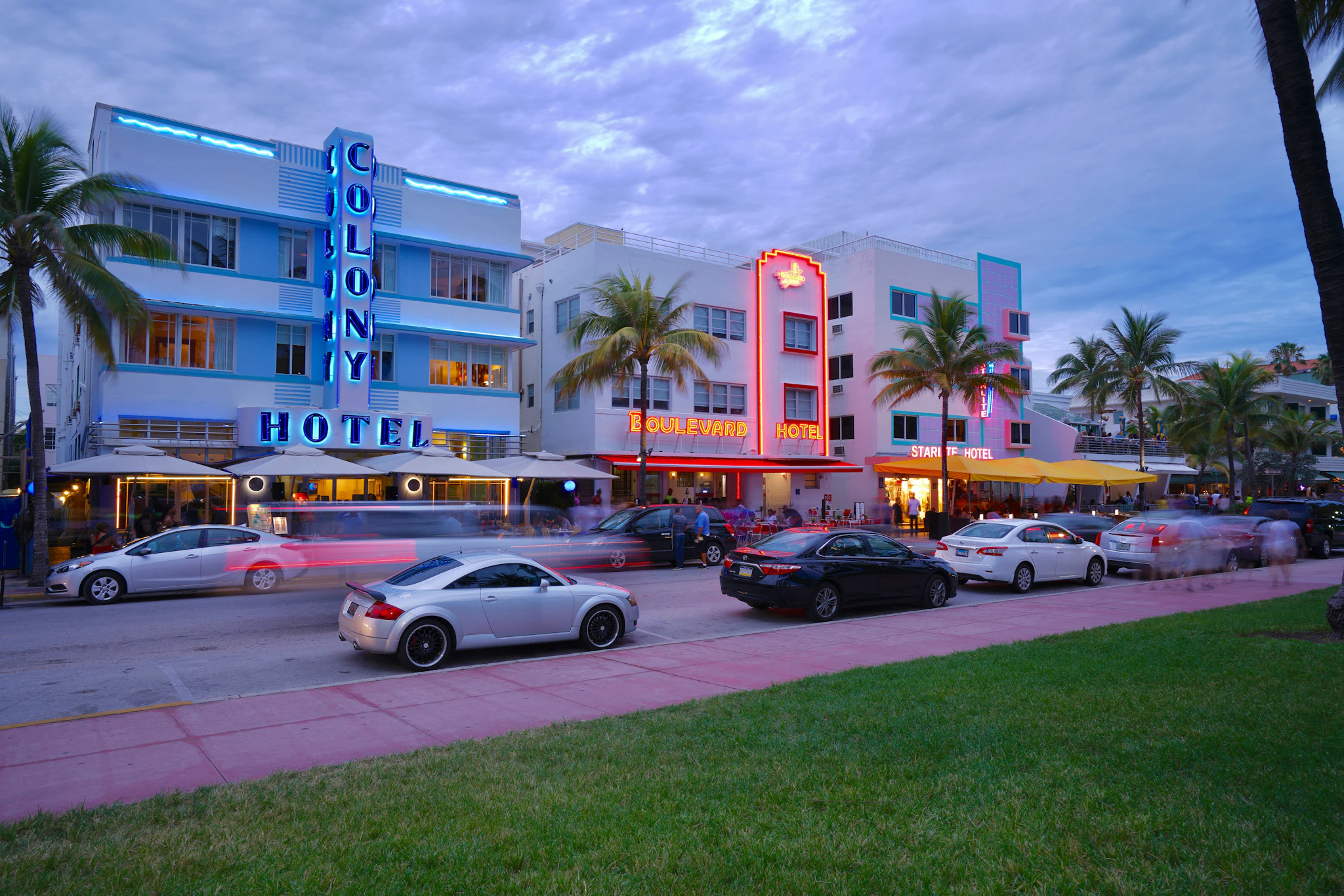
Miami Beach is known for more than its beaches. South Beach contains one of the country’s most recognizable collections of Art Deco architecture, while museums, performance venues, and contemporary cultural spaces add to the city’s longstanding connection to art and design.
Much of that history remains part of Miami Beach today. Restored Art Deco hotels still line Ocean Drive, The Bass brings contemporary art to Collins Park, and the Frank Gehry-designed New World Center presents concerts just blocks from the historic district. In Mid-Beach, the Faena District adds contemporary architecture, art, performance, and dining to the mix.
After dark, Miami Beach offers just as much variety. LIV at Fontainebleau remains one of its best-known nightclubs, while Española Way and landmark hotels throughout the island offer restaurants, bars, live entertainment, and places to spend an evening without stepping inside a club.
Why Is Miami Beach Famous for Art Deco Architecture?
Miami Beach contains one of the world’s largest and most recognizable concentrations of Art Deco architecture. Much of it sits within the Miami Beach Architectural District in South Beach, where hundreds of historic hotels, apartment buildings, and commercial properties date primarily from the 1920s through the 1940s.
Ocean Drive provides the most familiar introduction. Pastel façades face Lummus Park and the Atlantic, with many buildings displaying the streamlined shapes, geometric ornament, and decorative details associated with Miami Beach Art Deco. After dark, neon signs and illuminated façades give the same blocks a markedly different appearance.
The architecture also reflects its South Florida setting. Many buildings incorporate nautical references, including porthole-style windows and railings reminiscent of ocean liners, alongside terrazzo floors, decorative glass, curved corners, and horizontal lines. Tropical colors and motifs helped distinguish Miami Beach’s interpretation of Art Deco from examples found elsewhere.
Look for these Art Deco details:
- Geometric forms: Repeating lines, circles, chevrons, and symmetrical patterns decorate many façades.
- Rounded corners: Curved building edges and horizontal bands create the streamlined appearance associated with the period.
- Nautical influences: Porthole windows, railings, and other details reference 1930s ocean liners.
- Pastel colors: Pinks, blues, greens, yellows, and creams have become closely associated with the Miami Beach streetscape.
- Terrazzo and decorative flooring: Original and restored examples remain visible in the entrances and interiors of many historic buildings.
- Neon: Signs and architectural lighting make some of the district’s best-known buildings particularly striking after sunset.
Ocean Drive represents only one part of the historic district. Collins Avenue, Washington Avenue, and the surrounding streets contain additional Art Deco landmarks alongside Mediterranean Revival buildings and later examples of Miami Modern, or MiMo, architecture.
That concentration makes South Beach particularly rewarding to explore on foot. Within a relatively small area, visitors can see several important periods of Miami Beach architecture while many of the original buildings continue to operate as hotels, restaurants, shops, and residences.
See the District With the Miami Design Preservation League
The Miami Design Preservation League has helped protect Miami Beach’s historic architecture since 1976. Its Art Deco Welcome Center on Ocean Drive also serves as a starting point for exploring the buildings and design details found throughout the surrounding historic district.
Guided walking tours cover more than Art Deco alone. Visitors learn how to identify the architectural styles found throughout South Beach, including Mediterranean Revival and Miami Modern, while hearing the history behind individual buildings and the preservation efforts that helped protect the district from redevelopment.
The organization offers several ways to explore:
- Guided Art Deco walking tours through the historic district.
- Self-guided audio tours for visitors who prefer to explore independently.
- Private tours that can be arranged in advance for a more personalized look at the district.
Unlike a traditional historic site, South Beach’s architectural landmarks remain part of the neighborhood around them. Many continue to operate as hotels, restaurants, residences, and businesses, keeping the architecture connected to the Miami Beach of today.
Where Can You Experience Art and Culture in Miami Beach?
Miami Beach’s cultural scene extends well beyond its historic architecture. Contemporary art, design collections, classical music, performance, and modern architecture all have a place on the island, with several important institutions concentrated between South Beach and Mid-Beach.
The Bass
Located in Collins Park near the northern edge of South Beach, The Bass focuses on international contemporary art. Rather than relying on a permanent collection displayed in the same way year after year, the museum presents changing exhibitions, large-scale installations, and work by established and emerging artists.
The building also connects to Miami Beach history. The museum occupies the former Miami Beach Public Library and Art Center, originally designed by Russell Pancoast and opened in 1930. Later expansions transformed the interior while preserving the historic façade, bringing contemporary exhibition spaces into one of the city’s early Art Deco buildings.
The Bass is also particularly easy to incorporate into a broader day in Miami Beach. Collins Park sits directly outside, the Atlantic is only a few blocks away, and the Art Deco Historic District begins just to the south.
The Bass highlights:
- International contemporary art and changing exhibitions.
- Large-scale installations and public art.
- Historic 1930 Art Deco building in Collins Park.
- Convenient location near the beach and northern South Beach.
The Wolfsonian–FIU
The Wolfsonian–FIU provides a closer look at the design and visual culture of the period that helped shape modern Miami Beach. Located in the Art Deco Historic District, the museum holds a collection of more than 200,000 objects, primarily dating from 1850 to 1950.
Furniture, industrial design, ceramics, glass, posters, books, paintings, and other objects explore how design responded to major changes in politics, technology, transportation, and everyday life. Propaganda and graphic design also form an important part of the collection.
The Wolfsonian–FIU highlights:
- More than 200,000 works, objects, books, and other materials.
- Strong collections in decorative arts, industrial design, and graphic design.
- Posters and propaganda examining the relationship between design and politics.
- Located within the Art Deco Historic District on Washington Avenue.
New World Center
Near Lincoln Road, New World Center introduces a very different period of Miami Beach architecture. Frank Gehry designed the building as the home of the New World Symphony, and it opened in 2011 as both a concert hall and an advanced multimedia performance space.
Inside, the main performance hall uses an unconventional configuration designed to bring audiences closer to the musicians. Projection surfaces and multimedia technology allow performances to extend beyond the traditional concert format, while the soaring atrium makes Gehry’s architecture part of the visit before guests reach their seats.
Outside, the building faces SoundScape Park. During select events, the New World Symphony presents its WALLCAST concerts, projecting performances from inside the hall onto the building’s large exterior wall for audiences gathered in the park.
New World Center highlights:
- Frank Gehry-designed home of the New World Symphony.
- Concerts, special performances, and multimedia programming.
- WALLCAST concerts presented outdoors at SoundScape Park.
- Steps from Lincoln Road in central South Beach.
Faena Forum
Faena Forum brings contemporary art, performance, and events to Mid-Beach as part of the larger Faena District. OMA designed the building under the direction of Rem Koolhaas and Shohei Shigematsu, creating a 43,000-square-foot venue centered around flexible gathering and performance spaces.
Unlike The Bass or The Wolfsonian, Faena Forum does not operate primarily as a museum with galleries visitors can expect to tour at any time. Its calendar changes according to exhibitions, performances, talks, festivals, and private or special events.
Faena Forum highlights:
- Contemporary architecture by OMA.
- Art, performance, talks, and cultural programming.
- Part of the larger Faena District in Mid-Beach.
- Event-driven schedule worth checking before a visit.
Miami Beach After Dark
Miami Beach nightlife includes the major clubs that helped build South Beach’s reputation, but that is only one option. An evening might center on a headline DJ at Fontainebleau, dinner and drinks along Española Way, or cocktails inside one of the island’s landmark hotels.
Where you go depends largely on how much of the evening you want planned around a single destination.
LIV at Fontainebleau
LIV remains one of Miami Beach’s best-known nightclubs and a destination in its own right inside Fontainebleau Miami Beach. The club combines large-scale production, internationally known DJs and performers, and table service within an 18,000-square-foot, multi-level space.
Its location inside Fontainebleau also makes it possible to build the evening around the hotel. Dinner can come first at one of the resort’s restaurants, followed by drinks at Bleau Bar before heading to LIV later in the night.
LIV highlights:
- International DJs, performers, and special events.
- Multi-level nightclub inside Fontainebleau Miami Beach.
- Table service, banquettes, and private skyboxes.
- Several restaurants and bars elsewhere within the resort.
- Advance planning recommended for tables and major events.
Española Way After Dark
Española Way offers a more flexible alternative to spending the evening inside a single hotel or nightclub. The pedestrian street sits in the heart of South Beach, where Mediterranean Revival buildings frame restaurants and outdoor tables along the narrow blocks between Washington and Pennsylvania avenues.
Dinner is the main draw, but the location makes it easy to continue elsewhere afterward. Lincoln Road is nearby, as are the bars, hotels, and restaurants along Collins and Washington avenues. Ocean Drive and the Art Deco Historic District are also within walking distance.
That makes Española Way particularly useful for an evening without a fixed itinerary. Guests can choose a restaurant, stay for drinks, and decide where to go next without arranging transportation between every stop.
Española Way highlights:
- Pedestrian dining district in central South Beach.
- Mediterranean Revival architecture and outdoor dining.
- Restaurants and bars concentrated within a few blocks.
- Walking distance to Lincoln Road, Ocean Drive, and other South Beach nightlife.
- Well suited to an evening with several stops rather than one destination.
Cocktails Inside Miami Beach’s Landmark Hotels
Miami Beach’s landmark hotels are destinations even when you are not staying overnight. Several combine notable architecture and design with restaurants, bars, and entertainment, making them worthwhile stops for drinks before dinner or later in the evening.
Fontainebleau Miami Beach offers the most direct connection to the city’s resort history. Bleau Bar sits in the Chateau Lobby beneath the sweeping curves of Morris Lapidus’s 1954 design. The hotel’s restaurants and LIV nightclub are also nearby, making the bar an easy starting point for an evening that continues elsewhere within Fontainebleau.
The Setai offers a more intimate South Beach setting. Jo’s Bar sits between the hotel’s Jaya and Japón restaurants, providing a convenient place for cocktails before dinner or a drink afterward. The surrounding hotel combines its restored Art Deco building with contemporary design, giving the setting a character distinctly different from Fontainebleau.
Faena Hotel Miami Beach takes a more theatrical approach. Elaborate interiors, contemporary art, restaurants, bars, and live entertainment all occupy the Mid-Beach property. Depending on the evening, drinks can be paired with dinner at Los Fuegos, live music or entertainment, or simply time exploring the hotel itself.
Landmark hotel bar highlights:
- Bleau Bar: Resort history, Morris Lapidus architecture, and easy access to Fontainebleau dining and nightlife.
- Jo’s Bar: A quieter cocktail setting between two of The Setai’s signature restaurants.
- Faena: Cocktails alongside art, dining, elaborate interiors, and live entertainment.
These hotels offer an alternative to planning the night around a traditional club or bar district. They also make it easy to combine dinner, drinks, and entertainment in one destination without moving between several parts of Miami Beach.
Let Us Plan Your Time in Miami Beach
Some of Miami Beach’s most memorable plans benefit from arranging ahead, whether that means a private architectural tour, tickets to a performance, dinner at a landmark hotel, or a table for a late night at LIV.
The Maimon Group concierge team can assist with cultural experiences, restaurant and nightlife reservations, table service, and private transportation. For evenings that include several stops, our team can coordinate the details from the first reservation through the return to your villa.
Please tell us what you have in mind, and we’ll help plan a Miami Beach itinerary that brings it together.