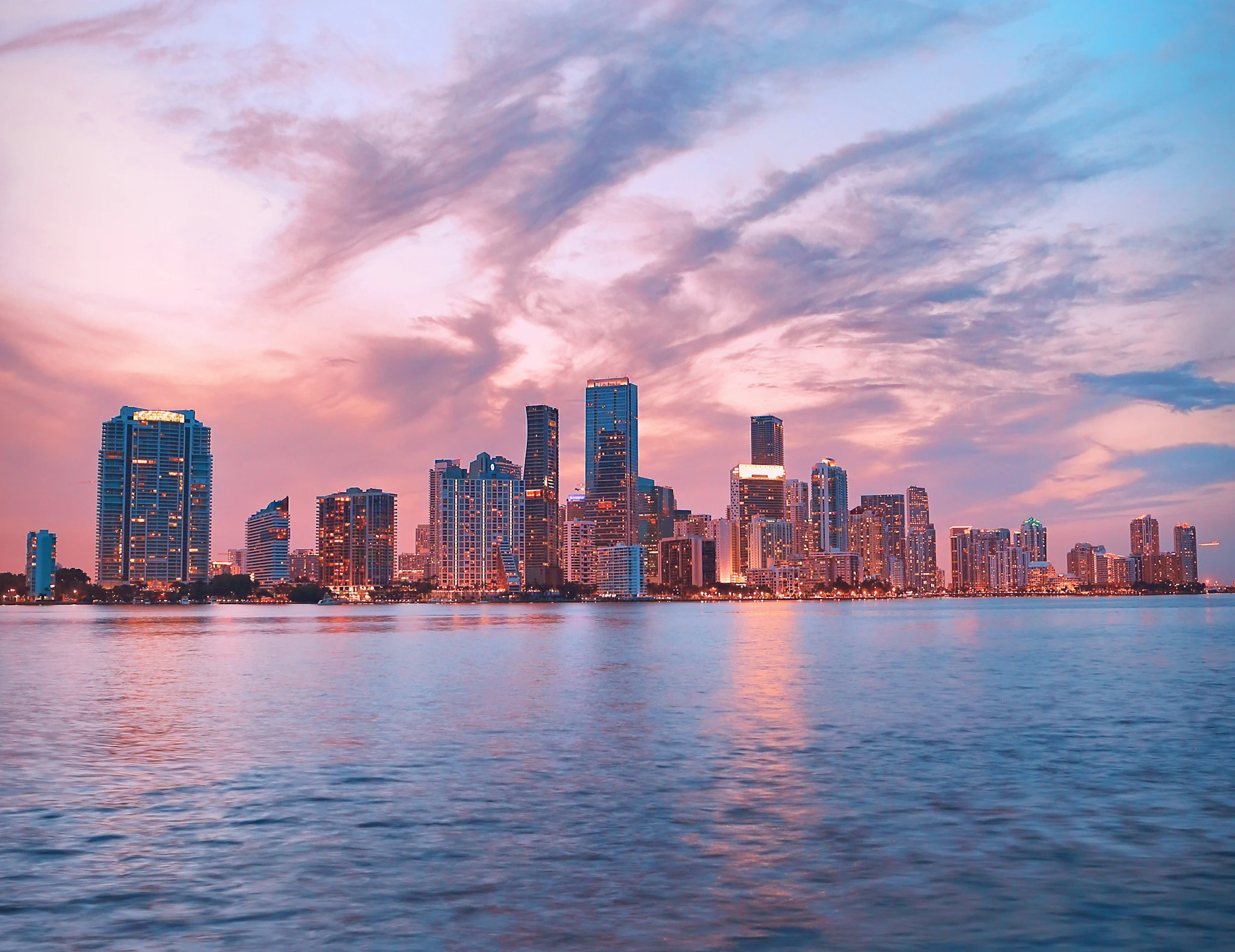
A Miami Beach stay puts much more than the island within reach. Cross Biscayne Bay, and you’ll find some of Miami’s most interesting art, architecture, shopping, museums, and dining concentrated in neighborhoods you can explore individually or combine into a day on the mainland.
Wynwood is known for street art and galleries, while the Miami Design District brings together contemporary art, architecture, and international fashion houses. Farther south, Vizcaya Museum and Gardens offers a look at early 20th-century Miami, and Downtown and Brickell add major museums, waterfront spaces, restaurants, and rooftop bars.
These destinations are close enough to Miami Beach to visit without changing where you stay. With transportation planned around traffic and reservations, a private villa on the island can remain the home base for exploring both sides of Biscayne Bay.
Wynwood: Street Art, Galleries & Dining
Wynwood sits just north of Downtown Miami and has become one of the city’s best-known arts districts. Former warehouses and industrial buildings now house galleries, restaurants, shops, studios, and creative businesses, while murals and large-scale works appear throughout the surrounding streets.
Wynwood Walls remains the neighborhood’s most recognizable attraction, but it should not be the only reason to visit. The larger district rewards time on foot, particularly for visitors interested in contemporary art, independent businesses, and a less formal alternative to Miami’s traditional museum districts.
Start at Wynwood Walls
Wynwood Walls opened as an outdoor showcase for street and graffiti art and has since featured artists from around the world. Today, the ticketed outdoor museum includes more than 38 murals and sculptures, galleries, and additional art experiences within its grounds.
The scale makes the work markedly different from viewing street art one mural at a time. Large exterior walls become canvases in their own right, with different artists working across painting, lettering, portraiture, abstraction, and other approaches to public art.
Wynwood Walls highlights:
- More than 38 murals and sculptures within the museum.
- Work by internationally recognized street and graffiti artists.
- Official guided and private tour options.
- Galleries and additional art spaces within the complex.
- Street-art experiences for visitors interested in the techniques behind the work.
Explore Beyond the Walls
Wynwood Walls provides a useful starting point, but much of Wynwood’s appeal sits outside its gates. Murals cover buildings throughout the surrounding blocks, and galleries, studios, boutiques, cafés, bars, and restaurants occupy many of the former warehouses that helped define the neighborhood.
The art also changes. New murals replace earlier works, galleries rotate exhibitions, and individual businesses come and go, so Wynwood rarely looks exactly the same from one visit to the next.
Walking several blocks beyond NW 2nd Avenue provides a broader view of the district than visiting Wynwood Walls alone. It also makes it easier to combine art with shopping, drinks, or a meal rather than treating the neighborhood as a single attraction.
Beyond Wynwood Walls:
- Street murals and public art throughout the surrounding blocks.
- Contemporary galleries and artist spaces.
- Independent shops and design-focused businesses.
- Restaurants, breweries, cafés, and bars within walking distance.
- A compact central district that works well for exploring on foot.
Where to Eat in Wynwood
Wynwood’s dining scene has grown alongside the neighborhood’s galleries and creative businesses. Restaurants now range from longstanding local favorites to ambitious dining rooms that draw visitors to the neighborhood specifically for a reservation.
For a day built around Wynwood Walls and the surrounding galleries, these are a few places worth knowing.
Doya
Doya specializes in Aegean cooking influenced by Greek and Turkish cuisines. Chef Erhan Kostepen’s menu centers on meze and dishes prepared over wood and charcoal, with much of it designed for sharing. The restaurant also has a large garden patio that works particularly well for Miami’s climate.
Doya has become one of Wynwood’s established dining destinations and remains recognized by the Michelin Guide. Its location on NW 24th Street also puts it close to Wynwood Walls and the center of the arts district.
Doya highlights:
- Aegean dishes influenced by Greek and Turkish cooking.
- Meze and shareable plates.
- Wood- and charcoal-fired meats and seafood.
- Indoor dining and a substantial garden patio.
- Convenient location for lunch or dinner after exploring Wynwood.
KYU
KYU built its reputation around wood-fired, Asian-inspired cooking. The open-fire approach runs through much of the menu, from meats and vegetables to several of the restaurant’s signature dishes.
The dining room has more activity than some of the neighborhood’s quieter restaurants, making KYU particularly well suited to a lively dinner after the galleries and shops have closed. Reservations remain a good idea, especially later in the week.
KYU highlights:
- Asian-inspired menu centered on wood-fired cooking.
- Shareable dishes suited to groups.
- Cocktails and a lively dining room.
- Central Wynwood location.
- Lunch, brunch, and dinner options depending on the day.
Zak the Baker
For breakfast or lunch, Zak the Baker has a very different place in Wynwood’s food scene. Zak Stern founded the independent artisan bakery in Miami in 2012 before opening its first Wynwood storefront in 2014. Today, the bakery and café produces its bread, pastries, and savory dishes in-house and remains one of the neighborhood’s enduring local businesses.
Naturally leavened breads remain central to the operation, joined by pastries, breakfast dishes, sandwiches, and other café offerings. The bakery is certified kosher and currently opens Sunday through Friday, closing on Saturdays.
Zak the Baker highlights:
- Naturally leavened artisan breads made on site.
- Pastries and a full café menu.
- Breakfast and lunch rather than an evening reservation.
- Certified kosher.
- A Wynwood fixture for more than a decade.
Miami Design District: Fashion, Art & Architecture
A short drive northeast of Wynwood, the Miami Design District brings together luxury fashion, contemporary art, architecture, furniture and design showrooms, and restaurants within a compact neighborhood.
Shopping is certainly one reason to visit. Major international fashion and jewelry houses have flagship boutiques here, making the Design District Miami’s primary destination for luxury retail. But treating it only as a shopping district misses much of what sets it apart.
The neighborhood has invested heavily in architecture and public art. Buildings by internationally known architects sit alongside installations, sculptures, landscaped public spaces, and galleries, while ICA Miami provides a major contemporary-art institution at the center of the district.
That combination makes the Design District easy to explore even when shopping is not the primary reason for visiting. The streets themselves provide much of the visual interest, with art and architecture integrated throughout the neighborhood rather than confined to a single museum.
Luxury Shopping in the Design District
The Design District has one of the country’s largest concentrations of luxury fashion, jewelry, and watch boutiques. Louis Vuitton, Dior, Gucci, Hermès, Cartier, Prada, Saint Laurent, and other international houses operate stores within a few blocks of one another.
Unlike a traditional enclosed shopping center, the boutiques occupy individual buildings and architect-designed storefronts throughout the neighborhood. Several brands have commissioned distinctive facades and interiors specifically for their Miami locations, making the retail architecture part of the district itself.
Design District shopping highlights:
- International fashion, jewelry, and watch flagships.
- Major houses concentrated within a walkable area.
- Architect-designed boutiques and distinctive facades.
- Personal shopping and private appointments available through select brands.
- Restaurants and contemporary art within the same district.
ICA Miami: Contemporary Art in the Design District
The Institute of Contemporary Art, Miami sits at the center of the Design District and gives the neighborhood a cultural anchor beyond its shops and showrooms. The museum focuses on contemporary art, with exhibitions that bring together established international artists, emerging voices, and work that may receive less attention from larger institutions.
Its exhibition program changes throughout the year. Current 2026 shows include work by Harmony Korine, Manoucher Yektai, Manuel Chavajay, and Igshaan Adams, alongside selections from ICA Miami’s permanent collection. The museum also maintains a sculpture garden with works on long-term view.
ICA Miami highlights:
- Changing contemporary-art exhibitions across several gallery levels.
- Works from ICA Miami’s permanent collection.
- Outdoor sculpture garden.
- Free general admission.
- Free daily tours at noon.
- Central location within the Miami Design District.
Art and Architecture Beyond the Museum
The Design District does not confine art and design to galleries. Public works appear throughout plazas, sidewalks, building facades, and courtyards, while individual architects and designers have transformed even practical structures into landmarks.
One of the best-known examples is Buckminster Fuller’s Fly’s Eye Dome in Palm Court. Fuller originally conceived the geodesic structure as an autonomous dwelling in the 1960s and developed prototypes in the following decades. The version installed in the Design District realizes that concept using contemporary materials and fabrication techniques.
Even the neighborhood’s parking structures have received architectural attention. Museum Garage brings together five different design practices across a single facade. Each received a section to design independently, producing a deliberately mismatched composition inspired by the Surrealist game Exquisite Corpse.
Those landmarks sit among a much larger collection of public works. The district maintains installations by artists and designers including the Campana Brothers, Criola, Daniel Toole, and others throughout the neighborhood.
Design District art and architecture highlights:
- ICA Miami and its outdoor sculpture garden.
- Buckminster Fuller’s Fly’s Eye Dome in Palm Court.
- Museum Garage and its five distinct architectural facades.
- Public sculpture, murals, and installations throughout the district.
- Architect-designed luxury boutiques and showrooms.
- Landscaped plazas and pedestrian spaces that make the neighborhood easy to explore on foot.
As a result, shopping does not have to be the focus of a Design District visit. Someone interested primarily in contemporary art and architecture can spend several hours here without entering a fashion boutique.
Vizcaya Museum and Gardens: A Look at Early Miami
South of Downtown Miami, Vizcaya Museum and Gardens offers a very different look at the city. The waterfront estate predates the Art Deco hotels of Miami Beach and provides a window into Miami during the early decades of the 20th century.
Industrialist James Deering began building Vizcaya as his winter residence in the 1910s, creating an elaborate estate inspired by European villas while adapting it to its subtropical Biscayne Bay setting. The property combines the main house with extensive formal gardens, historic outbuildings, and a waterfront overlooking the bay.
Inside, rooms incorporate European furniture, decorative arts, architectural elements, and antiques collected across centuries. The intention was never to reproduce one historic period precisely. Instead, Deering and the estate’s designers combined different European influences to create a highly personal interpretation of an old-world villa in South Florida.
The gardens deserve as much time as the house. Formal spaces, fountains, sculptures, grottos, and dense subtropical planting extend toward Biscayne Bay, while the estate’s distinctive stone barge sits just offshore.
Vizcaya highlights:
- Early 20th-century waterfront estate on Biscayne Bay.
- Elaborately furnished main house.
- European decorative arts and architectural details.
- Extensive formal gardens and subtropical landscaping.
- Historic waterfront and stone barge.
- A dramatically different architectural period from Miami Beach’s Art Deco district.
Pérez Art Museum Miami: Contemporary Art on Biscayne Bay
Pérez Art Museum Miami sits on the Downtown Miami waterfront in Maurice A. Ferré Park, with Biscayne Bay immediately beyond the museum. Its location makes the building and surrounding landscape nearly as important to a visit as the galleries themselves.
PAMM focuses on modern and contemporary art, with a permanent collection of nearly 3,000 works and a particular emphasis on artists and traditions connected to Latin America, the Caribbean, the African diaspora, and the U.S. Latinx experience.
The museum moved to its current waterfront home in 2013. Pritzker Prize-winning architects Herzog & de Meuron designed the 200,000-square-foot building specifically for Miami’s subtropical setting. Deep overhangs provide shade, tropical vegetation hangs from the canopy, and broad outdoor spaces connect the museum with the park and bay. Windows placed throughout the galleries also bring views of the surrounding waterfront into the building.
That setting makes PAMM easy to enjoy beyond the galleries. Visitors can spend time on the museum’s shaded terraces, walk through Maurice A. Ferré Park, or continue along the Downtown Miami waterfront before heading elsewhere in the city.
PAMM highlights:
- Modern and contemporary art with strong connections to Miami, Latin America, the Caribbean, and the African diaspora.
- Nearly 3,000 works in the permanent collection.
- Changing temporary exhibitions throughout the year.
- Herzog & de Meuron-designed waterfront building.
- Outdoor terraces and views across Biscayne Bay.
- Location within Maurice A. Ferré Park in Downtown Miami.
Brickell: Dining, Rooftops & Contemporary Miami
Continue south from Downtown, and the city changes again. Brickell is Miami’s high-rise financial and residential district, with glass towers, hotels, restaurants, shopping, and rooftop bars concentrated along and around Brickell Avenue.
For visitors staying in Miami Beach, Brickell makes the most sense when dining or drinks are part of the reason for crossing the bay. It can also pair naturally with Vizcaya, which sits farther south along Biscayne Bay, or with PAMM and Downtown for a longer mainland outing.
Brickell City Centre provides a central point for shopping and dining, while restaurants and bars extend throughout the surrounding streets and hotels. High-rise rooftops also take advantage of something Miami Beach cannot offer in quite the same way: elevated views across the Downtown skyline and Biscayne Bay.
Sugar at EAST Miami
On the 40th floor of EAST Miami, Sugar combines a rooftop garden setting with cocktails, Asian-inspired share plates, DJs, and expansive views over the city.
Its location at Brickell City Centre makes it particularly convenient after shopping or dinner nearby. The rooftop currently opens in the late afternoon and continues into the early morning, shifting from cocktails around sunset toward a more nightlife-oriented setting later in the evening.
Rosa Sky
Rosa Sky offers another perspective from the 22nd floor in central Brickell. The rooftop serves cocktails and globally influenced shareable plates, with DJs and programming later in the evening.
The emphasis here is more firmly on the lounge and nightlife experience, making Rosa Sky a better choice for guests who want the rooftop itself to be the evening’s destination rather than simply a stop for a drink.
Brickell highlights:
- Restaurants, hotels, and shopping concentrated within the high-rise district.
- Brickell City Centre for luxury shopping and dining.
- Rooftop bars with elevated views across Miami.
- Sugar at EAST Miami for cocktails, share plates, and a garden rooftop setting.
- Rosa Sky for cocktails, DJs, and a livelier late-night atmosphere.
- Convenient pairing with Downtown Miami, PAMM, or Vizcaya depending on the day.
Brickell is less about checking off a single landmark than choosing what brings you there. A restaurant reservation, shopping, or drinks above the skyline can provide the reason to spend an evening on the mainland before returning across Biscayne Bay to Miami Beach.
Visiting During Miami Art Week
Each December, Miami becomes one of the most important destinations on the international art calendar. Miami Art Week brings collectors, galleries, artists, designers, and visitors to fairs, exhibitions, installations, dinners, and events across Miami Beach and the mainland.
Art Basel Miami Beach is the best-known event, but it is only one part of the week. The fair takes place at the Miami Beach Convention Center, while additional fairs and cultural programming extend through Miami Beach, Wynwood, the Design District, Downtown Miami, and other parts of the city.
Art Basel Miami Beach
Art Basel Miami Beach brings leading galleries from around the world to the Miami Beach Convention Center each December. The fair covers modern and contemporary art across painting, sculpture, photography, digital work, large-scale installations, and other media.
For guests staying in Miami Beach, its location is particularly convenient. The Convention Center sits near Lincoln Road, The Bass, and several of South Beach’s major hotels, putting the centerpiece of Miami Art Week on the island itself.
Art Basel Miami Beach highlights:
- Leading international galleries exhibiting modern and contemporary art.
- Major works alongside emerging artists and new presentations.
- Large-scale installations and special programming.
- Miami Beach Convention Center location.
- Annual December dates during Miami Art Week.
Art Week Across Miami
Some of the most interesting programming during Miami Art Week happens beyond the Convention Center. Museums introduce exhibitions around the December calendar, galleries schedule openings, brands host installations and events, and additional art fairs draw visitors to different parts of Miami.
Where to look during Miami Art Week:
- Miami Beach: Art Basel Miami Beach anchors the week, joined by satellite fairs, exhibitions, hotel events, and programming throughout the island.
- Wynwood: Galleries, street art, exhibitions, brand activations, and special events add to an area already centered on contemporary art.
- Miami Design District: Galleries, fashion houses, ICA Miami, public art, and temporary installations make the neighborhood one of the busiest mainland destinations during the week.
- Downtown Miami: PAMM and other cultural institutions often schedule exhibitions and programming to coincide with the influx of art-world visitors.
How Do You Get From Miami Beach to Mainland Miami?
Biscayne Bay separates Miami Beach from the mainland, but several causeways provide direct connections to the neighborhoods covered in this guide. The best route depends on where you are staying and where you are headed.
For guests planning several mainland stops, geography matters. Wynwood and the Design District sit relatively close to one another north of Downtown, while PAMM lies farther south along the Downtown waterfront. Brickell and Vizcaya continue south from there.
Planning your route from Miami Beach:
- Wynwood and the Design District: These two neighborhoods make a natural pairing because of their proximity. From central Miami Beach, the Julia Tuttle Causeway provides one of the most direct routes toward this part of the mainland.
- Downtown Miami and PAMM: The MacArthur Causeway provides direct access between the southern portion of Miami Beach and Downtown Miami.
- Brickell: Continue south from Downtown to reach Brickell, making the two districts easy to combine when dining or drinks are part of the plan.
- Vizcaya: Located south of Brickell, Vizcaya works better as a dedicated destination or paired with another stop in the southern part of the city than with Wynwood or the Design District.
Travel times can vary significantly with traffic, events, and the time of day. That becomes especially important during Miami Art Week and other major events, when crossing Biscayne Bay can take considerably longer than the distance on a map suggests.
For guests planning museum tickets, shopping appointments, restaurant reservations, or several stops in one day, private transportation can reduce uncertainty around parking and moving between neighborhoods.
Plan Your Time Beyond Miami Beach With The Maimon Group
A private villa in Miami Beach can remain your home base while much more of Miami stays within reach. The Maimon Group concierge team can arrange private transportation for time in Wynwood, the Design District, Downtown, Brickell, and other parts of the city, along with reservations and experiences that fit your plans.
For guests interested in art and design, The Maimon Group’s concierge team can assist with museum and gallery visits, private tours, and personal shopping in the Design District. During Miami Art Week, planning can also help coordinate fair schedules, dining reservations, transportation, and other arrangements across Miami Beach and the mainland.
Let us plan the details beyond the island, then return to the privacy of your Miami Beach villa.