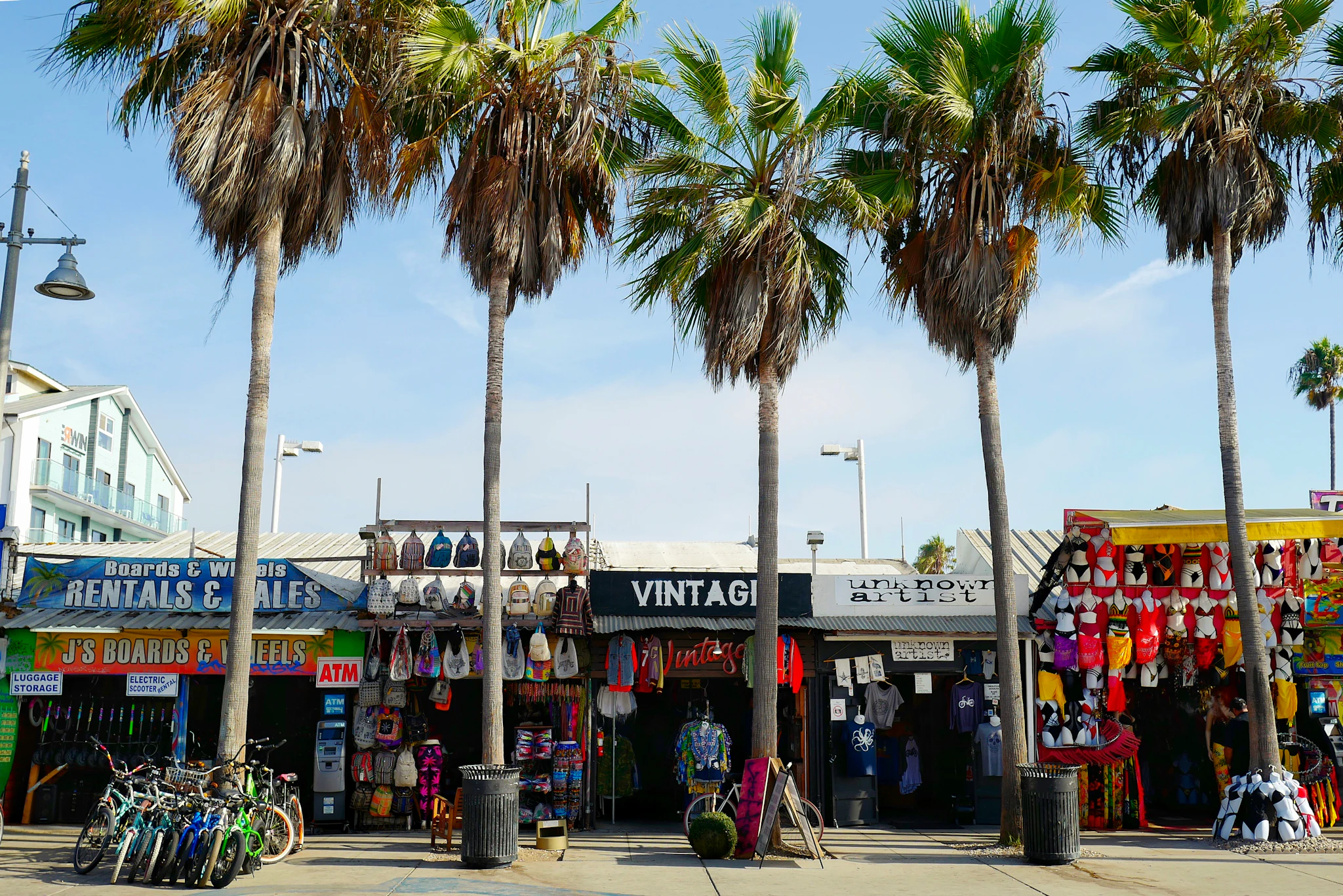
Venice feels different from almost every other neighborhood in Los Angeles. Historic canals sit just a few blocks from the Pacific. Contemporary homes stand beside restored Craftsman cottages. Murals cover building walls, while galleries and design studios occupy spaces tucked between cafés and restaurants. The result is a neighborhood with a character that feels distinctly its own.
None of it happened by accident. Venice has spent more than a century reinventing itself, with each generation leaving its mark on the neighborhood. Understanding that evolution offers a deeper appreciation for the places visitors experience today.
The Vision of Abbot Kinney
Long before Venice became associated with surfing, skateboarding, and one of Los Angeles' best-known shopping streets, developer Abbot Kinney imagined something entirely different.
Inspired by Venice, Italy, he set out to create "Venice of America," a seaside community connected by canals, footbridges, gardens, cultural attractions, and public gathering places. When the resort opened in 1905, it quickly became one of Southern California's most popular destinations, attracting visitors who came as much for the experience as for its coastal location.
As Los Angeles expanded and automobiles reshaped the city, many of the original canals were filled to make way for roads. The waterways that remain today preserve one of the defining elements of Kinney's original vision and continue to distinguish Venice from every other beach community in California.
A Neighborhood That Welcomed New Ideas
By the 1960s and 1970s, Venice had become a place where artists, architects, and designers found room to experiment. The neighborhood's modest homes, former industrial buildings, and unconventional character offered opportunities that were becoming increasingly difficult to find elsewhere in Los Angeles.
Frank Gehry was among the architects drawn to Venice during this period. Several of his early residential projects helped establish the neighborhood as an important destination for contemporary architecture, demonstrating that innovative design could exist comfortably alongside older homes rather than replacing them.
That spirit remains visible today. Restored Craftsman cottages stand beside contemporary residences, former warehouses have found new purpose, and the neighborhood's walk streets reveal decades of architectural ideas rather than a single defining style.
Art That Belongs to Everyone
Venice has never limited art to formal galleries. Murals appear throughout the neighborhood, transforming building façades, alleyways, and public spaces into an outdoor collection that continues to evolve. Some works become familiar landmarks for years, while others give way to new artists and new ideas.
The Venice Art Walls remain one of the neighborhood's defining creative landmarks. Originally part of the Venice Pavilion, they continue to provide one of the few legal public spaces in the United States where graffiti artists can create large-scale work in full view of the public. The walls are never finished, which is part of what makes them worth revisiting.
Galleries & Creative Spaces
Public art may be the most visible expression of Venice's creative identity, but galleries remain an important part of the neighborhood's cultural life.
Established spaces such as L.A. Louver have introduced internationally recognized contemporary artists to Los Angeles audiences for decades, while smaller galleries continue to showcase emerging work. Together, they reflect a neighborhood where creating and collecting art remain part of everyday life.
That creative community extends well beyond the galleries themselves. Artists, designers, and makers continue to live and work throughout Venice, contributing to a neighborhood where creativity is something people encounter naturally rather than seek out.
The Maimon Experience
Understanding Venice's history adds another dimension to every walk through the neighborhood.
The Maimon Group can arrange architecture-focused walking tours, curator-led gallery visits, and guided experiences exploring the history behind the canals, public art, and creative communities that continue to shape Venice. For guests with a particular interest in architecture, design, or contemporary art, experiences can also be tailored around working studios, local makers, and private collections where available.
Whether your interests lie in architecture, public art, or the neighborhood's remarkable history, these experiences offer a deeper understanding of the community that continues to make Venice one of Los Angeles' most distinctive places to explore.